 Santa Cruz Mountain Photography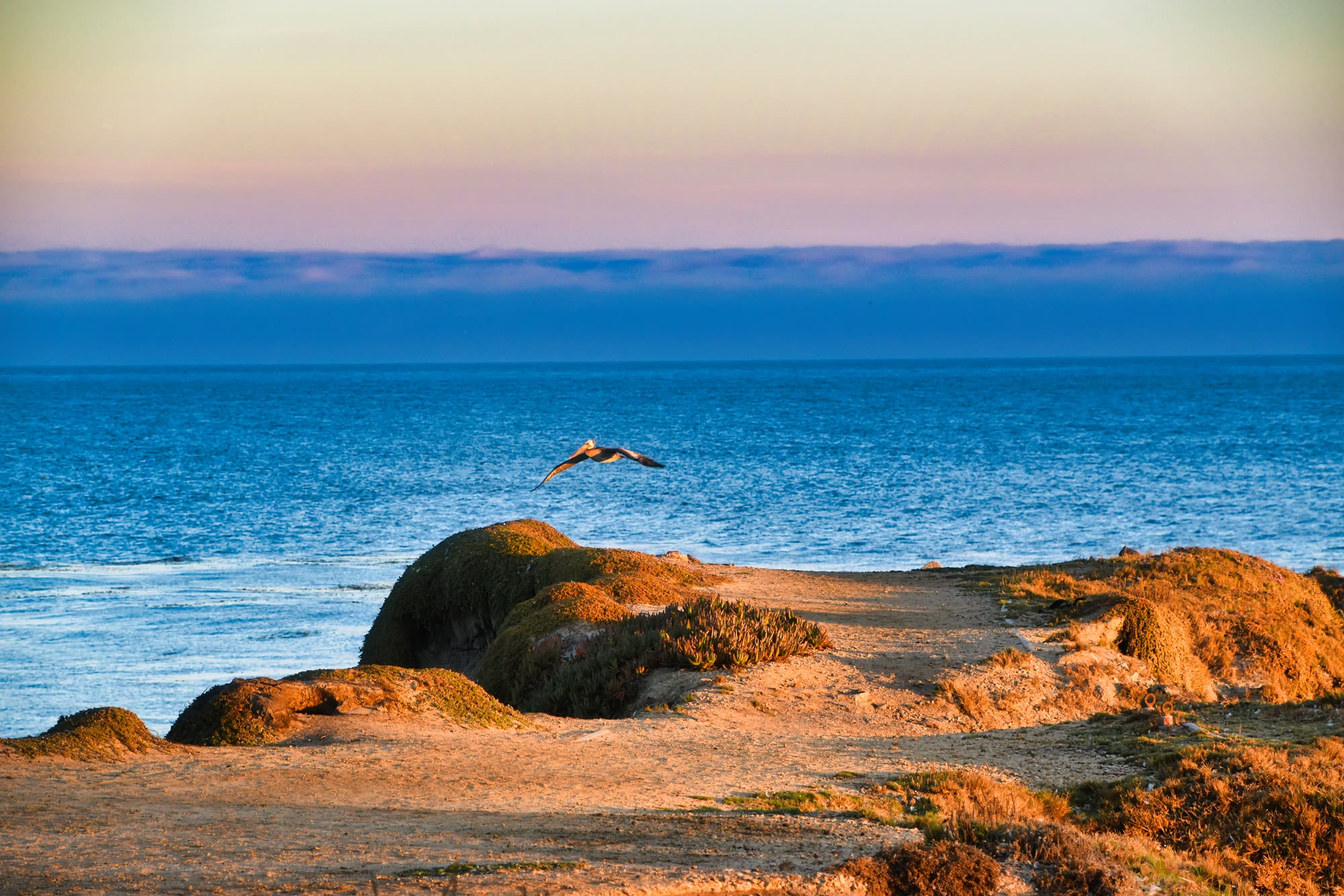
You don't need to go looking for wildlife along this coast. Pelicans work the surf line at pretty much any hour, sea lions haul out on the rocks off nearly every point, and gulls are, well, everywhere. The animals aren't the hard part. Getting a photo of them that's actually worth keeping is.
Pelicans
Brown pelicans fly low over the water in loose lines, gliding just above the wave crests, and that low flight path is what makes them such good subjects: you can shoot them against the water instead of a flat sky. The best light is early morning or the hour before sunset, when the water picks up color and the birds catch warm side light instead of being silhouetted flat against it. I track a bird in the frame before it's close, follow it through the shot, and keep firing rather than waiting for the "right" moment. They fold their wings and dive without warning, and that dive is usually the shot worth having, but it happens fast enough that you need to already be shooting to catch it.
Sea lions
Sea lions are the opposite problem: they're not moving much, so the challenge is composition rather than timing. A pile of sea lions on a rock can look like a pile of sea lions on a rock unless you find an angle that gives it some structure, low light raking across the rock, a single animal separated from the group, a wave breaking behind them for scale. Get there near low tide, when more rock is exposed and the animals have more room to spread out instead of stacking into one mass.
Gulls and other coastal birds
Gulls get dismissed because they're common, but a gull standing still on a rock with good light and a clean background is a perfectly good photo, and they're a lot more cooperative than pelicans if you're still learning to track a moving subject. They're a good place to start if you're working on wildlife photography yourself and want a subject that isn't going anywhere.
What actually matters
More than gear, what makes coastal wildlife photography work is time. I don't get the shot I want by walking up, taking a few frames, and moving on. I find a spot with decent light and good access to the water, and I wait, sometimes twenty minutes, sometimes longer, until something happens that's worth the frame. Most of what makes these photos work isn't a rare animal or exotic behavior. It's ordinary coastal wildlife caught at the one moment out of a hundred that actually reads as a photograph instead of a sighting.
If you want wildlife or nature photography along this coast, for yourself or as part of a larger shoot, get in touch.